
Executive Director Dr. Patrick Button Awarded Prestigious Research Grant from the Alfred P. Sloan Foundation
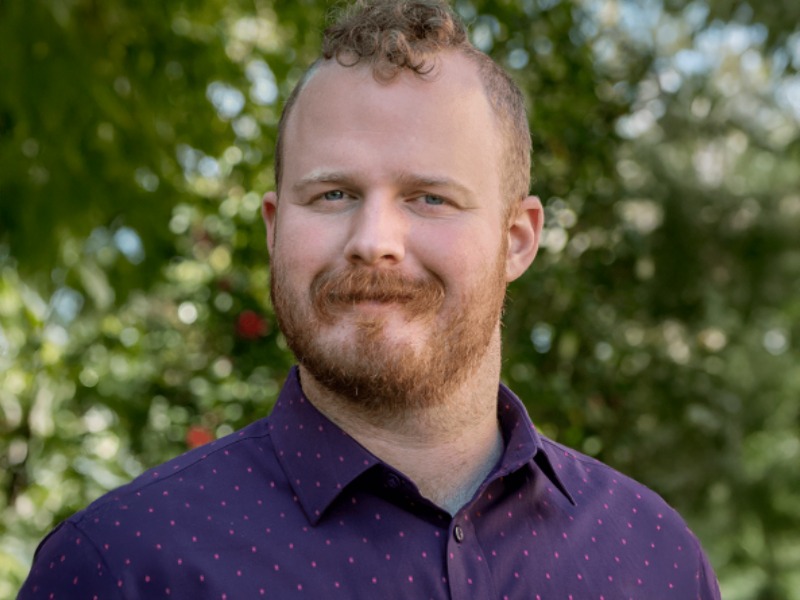
The Connolly Alexander Institute for Data Science (CAIDS) is pleased to announce that Dr. Patrick Button, executive director of CAIDS and associate professor of economics in the School of Liberal Arts, has been awarded a research grant from the Alfred P. Sloan Foundation in support of his ongoing work on discrimination in access to essential services.
The funded project, “Mortgage and Healthcare Discrimination During COVID-19 Pandemic and Use of Text Data in Economics,” which was previously funded by an NSF CAREER grant, supports Dr. Button’s audit correspondence field experiments examining how race, ethnicity, sexual orientation, gender identity, and their intersections, affect individuals’ experiences when seeking mortgage loans or mental health care. In these studies, Button and their team of research assistants send emails to mortgage loan officers and therapists to inquire about services, varying only demographic signals like names, gender identity, mental health conditions, and types of health insurance. Since demographic factors such as race and gender are on-average identical across inquiries — just like in a randomized control trial — comparing response quality by group provides an accurate measure of discrimination.
The Alfred P. Sloan Foundation grant will support the hiring and mentoring of research assistants in the Discrimination, Disparities, and Data Lab (D3L) for one year to complete the data collection and coding necessary for this work. The project will also evaluate how large language models (LLMs) can help detect subtle forms of discrimination in text-based communication, potentially offering new methodological guidance for social scientists.
“We will determine if people use less polite or helpful language when responding to inquiries from minoritized groups. Our goal is to develop new and better ways to detect subtle discrimination using LLMs. This ‘flips the script’ as it means using AI to detect discrimination, rather than the usual concern about AI causing discrimination,” Dr. Button said.